China & Web are two topics that mixed together often revolve around the Great Firewall and censorship. This is fair topic.
However, I think China has also nudged the development of new technologies in a direction that lead to a user experience and integration that do not exist in my more common countries where major corporations hold their rule tight on digital serfdom or technology simply took another path.
Another shape of digital leaders
Apple and Google have decided that it is fair for them to control everything
that lands on your device their devices. Every app has to go through their
scrutiny and to be sure
of this, an app can not host other “mini apps” or other arbitrary code within
it. And apps, have been expected for a long time to be done in an all native
style as much as possible.
In China, such rules do not apply and Alipay is a prime example of what it opens. While a lot of apps started under the vision “one feature / one app”, AliPay feels like the exact opposite, it is to the app ecosystem, what Yahoo tried to be for the Web. One entry point to a ridiculously large ecosystem.
AliPay is primarily a payment system on which I will come back. But it is also hosting a legion of other applications: DiDi (an uber equivalent), access to some public transport systems, access to some ubiquitous bike rental systems, it is even common for restaurants to take customer orders through their app.
The experience is frictionless. It is not presented like you have to create a new account, Alipay manages your identity like an OS authorization. It has already verified your phone and identity documents, it already has access to your payment information. Using an app feels like granting an authorization: “Allow XXX to access: your ID, your phone number”. Paying is handled at the master app level, which also centralizes all your receipts like you could expect on your bank account.
In my “out of China world” experience, using a new service is so painful, pick a new username, configure your email, confirm your phone, type again your card, confirm your email, here is your 2FA link, here is your 2FA code. The more poorly implemented services expire both session and 2FA on the next day or earlier (I am looking at you AWS).
If you do anything related to investment the nightmare goes on with your identity documents, proof of residency, proof of income. Every time the same information is requested for every new service. And … it will be requested over the years.
Contactless payment without NFC
Contactless payment? Apple Pay and Google Pay waited quietly for technology maturity. AliPay just displays a dynamic bar code, you scan it on the merchant’s machine and confirm the amount through a swipe on your phone.
NFC is a solution that was looking for a problem. It is interesting that 90% of its use cases are solvable using previously available technology.
Autotranslate everything
A few years back - which is a euphemistic to say more than a decade ago - I ran a few ads on the Chinese market through Baidu, which offers a similar in search result advertising to Google’s. In those days, I was surprised that such a behemoth did not have a translated interface. We did the whole process using Google Translate on a Chinese character interface.
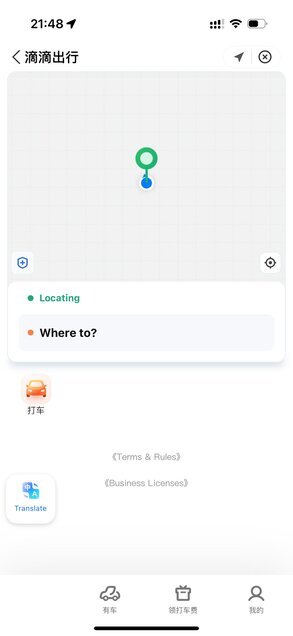
And, today? Well … the automated translation (bottom left) is an integrated de facto thing for most screens but not all. You just enable it and you will start to see the labels flicker and change language at every change of user interface. It works decently well.
If your app suddenly host thousands or more of smaller apps, that is a very efficient to bridge an accessibility gap!
